Premise
What begins as coffee and vinyl booth lunches on Thursdays becomes the deliberate, patient architecture of intimacy. Across diner plates, Maya maps the contours of Thomas's quiet guilt without him ever realizing he is being studied.
From the Manuscript
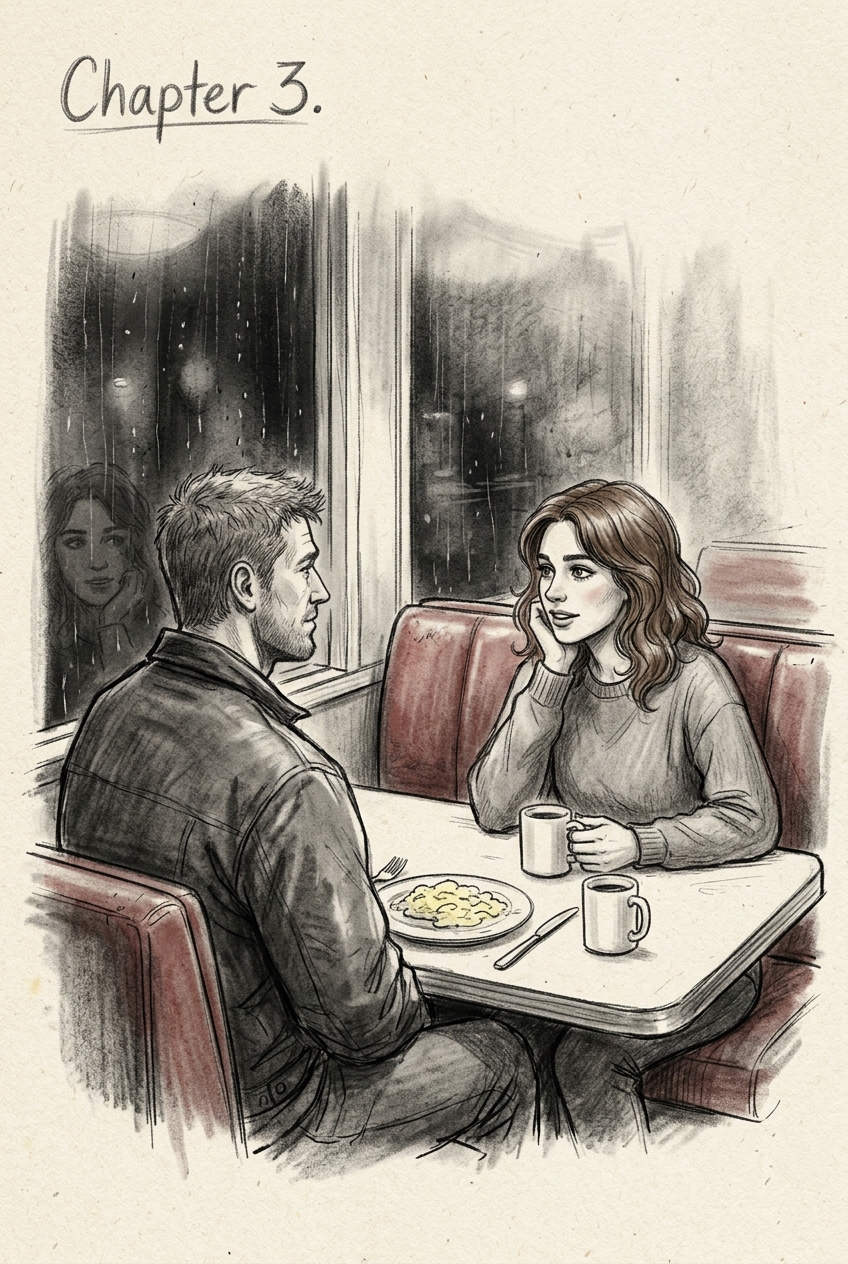
Two days later, at the diner on Delmore, Thomas sat across from her in a vinyl booth for their first lunch.
She mentioned a place on Delmore — not Delmore's, a diner two blocks past it, breakfast plate all day, vinyl seats repaired until the repairs had repairs. He'd never been. Surprise crossed her face like that was actually news. The following Thursday they were in the booth together and the window onto the street held both their reflections.
She'd taken this booth alone for a year — BLT, extra tomato, soup in winter, Thursdays that belonged to her before they belonged to *them*. Now he cut his eggs like the shape of them mattered and she ate her sandwich with the structural confidence of someone who had a method, tomato slipping off the side, and the booth felt smaller in a way that had nothing to do with space.
"You come here a lot," he said.
"Thursday lunches. About a year." She pulled a toothpick from the sandwich. "Used to be by myself."
He sat with that — a year of her in this booth alone — and his hand stayed on his fork a beat longer than eating required. She noticed. Her knee brushed his under the table and stayed.
"You were raised Catholic," she said.
"How did you know that."
"The way you straighten things. And the guilt." She took a bite. "Catholics carry it differently than everyone else. Baptists are guilty about what they did. Catholics are guilty about what they are."
He sat with that.
"I lapsed around twenty-three," he said.
"But you're still running meetings out of a Catholic church."
"Father Brennan has a good room."
"Father Brennan has terrible coffee."
"The room makes up for it."
— Belief and Love, Chapter 3