Premise
Five years after his life fractured, Thomas facilitates St. Christopher's Circle in a quiet church basement. He sets out forty folding chairs by feel—unaware that the woman who pauses at the doorway will spend the next four months delivering him to an altar.
From the Manuscript
By seven-forty, Thomas parked in the church lot and sat with the engine off. Through the side door he could see the light was already on in the back corridor — Father Brennan in early, the way he always was on meeting nights.
Thomas pushed the truck door open and crossed the lot. The cold had settled in the way it did in this part of November, the kind that had stopped bothering to announce itself and was simply there now, settled in for the season. He pulled the side door and Father Brennan looked up from the small desk he kept in the corridor, the one that had no business being there and had been there for twenty years.
"Thomas," the priest said.
"Father." Thomas nodded. "Thank you for the room."
Father Brennan waved this off the way he always did, as though the thanks were unnecessary and slightly embarrassing, which it probably was. He didn't ask what the group was for. He never had. Thomas had come to understand this as its own kind of generosity — the deliberate incuriosity of a man who had decided that people doing their best in the dark deserved a room without conditions attached.
He went through to the hall and hit the lights.
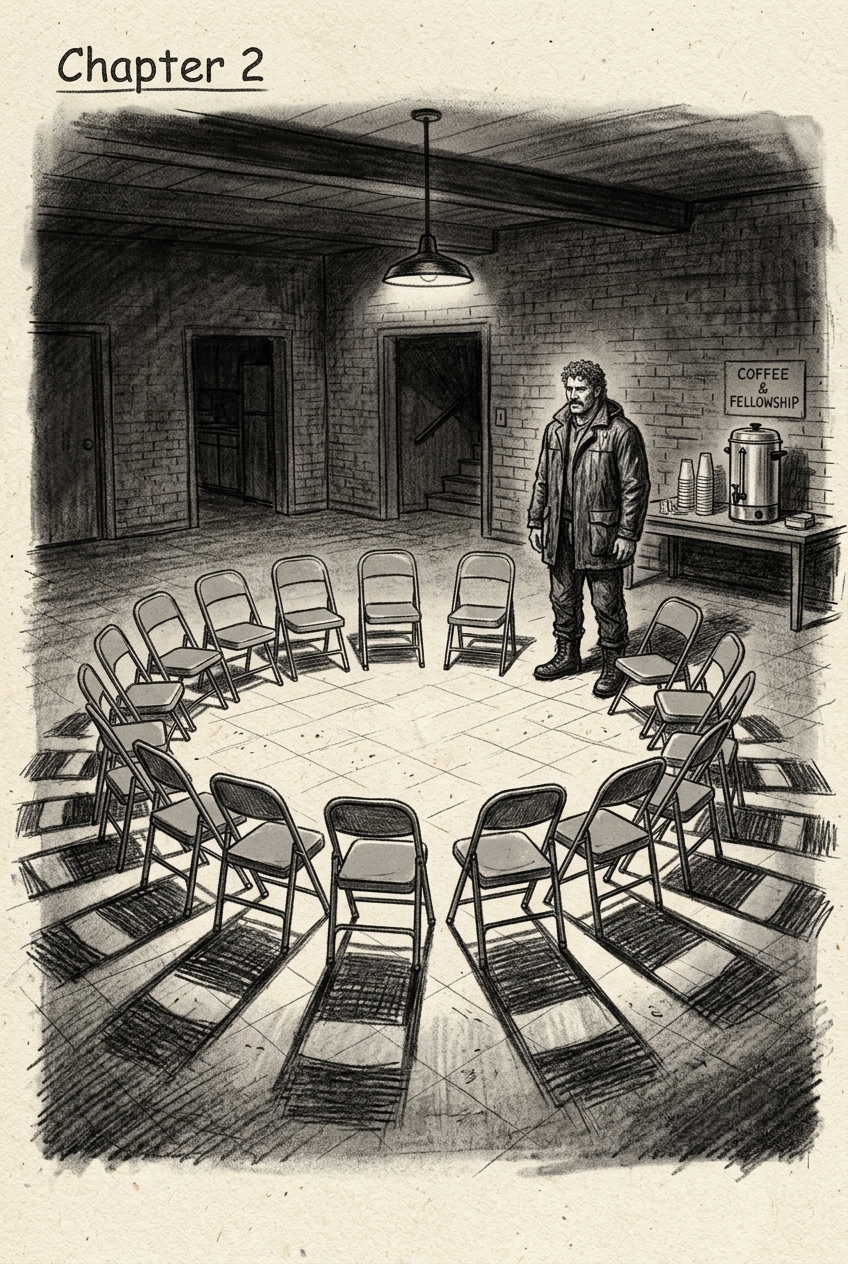
Inside, the yellow lights hummed as Thomas pulled down the stacked chairs, spacing forty of them by feel.
Forty of them now. That had crept up on him over the years — four the first night, then six, then a dozen, then the kind of growth that stopped feeling like growth and started feeling like the group finding its natural size. Forty chairs in a circle was a different thing than twelve. The room held it but only just, the circle pushed out toward the walls, the kitchen hatch behind him when he sat in the facilitator's seat. He set them out the way he always set them out, spacing by feel, no measuring required. His hands knew the distances. He straightened each one as he placed it. The straightening was unnecessary. He did it anyway.
The literature table next — the books, the chips, the sign-in sheet with its ruled lines and the pen on the string he'd replaced three times because people kept walking off with it without meaning to. He set the book open to no particular page and arranged the chips in the order they always went and smoothed the sign-in sheet flat against the table even though it was already flat.
The coffee took seven minutes. He stood in the small kitchen while it ran and listened to the hall settle around him — the quiet of a room waiting to be used, the tick of the fluorescent light above the serving hatch, the distant sound of traffic from the street. He had stood in this kitchen, or ones like it, more times than he could count. The smell of the coffee was the same every time. That was one of the things he'd come to rely on without noticing he was relying on it.
He poured himself the first cup and went and stood in the middle of the circle.
Forty chairs. Six years. Tuesday now instead of Thursday, which still felt wrong in his body even if it was right in every other way. He thought about that sometimes — the way a habit lived in the body independently of the mind, the way his hands had reached for his phone last Tuesday at seven-thirty the way they always reached for it on Thursday nights, checking whether anyone had texted to say they weren't coming. Nobody texted on Tuesdays. They would eventually. The body would catch up.
Marcus arrived first, the way Marcus always arrived first — coat still on, hands wrapped around a cup before Thomas had finished pouring it. Fifty-nine now, six years in the program, the kind of man who had arrived at a hard-won stillness through a long and expensive route and wore it carefully, like something that could be taken back. They nodded at each other. That was enough between them and had been for years.
Then Garrett, then Pete, then a cluster of four who'd started coming together about a year ago and still moved through the door as a unit, which Thomas had noticed and not remarked on because it was the kind of thing that sorted itself out. Diane, who had been coming since the early days when the room was half-empty and the silences were longer and harder. Ray. A handful of faces that had become familiar enough to read at a glance — who was having a bad week, who had something they were working up to saying, who needed to be left alone for the first twenty minutes and approached in the last five.
By five to eight the chairs were mostly full. Thomas looked around the circle and recognized the shift he expected at this point in the evening — not pride exactly, not satisfaction, something quieter than both. The room was real. The people in it were doing something hard. He got to be useful to that. After six years it still struck him the same way.
He was still at the door when she arrived.
She stopped just outside the threshold, one hand on the frame, eyes moving across the room. Young — mid-twenties at a glance. Coat too light for November, unbuttoned, dark scarf loose at her throat. Light brown hair over her shoulders. The kind of figure that stopped a room and she had no idea it did. Her face showed everything — the exhaustion, the hope underneath it, the raw undefended way of someone who had spent everything just getting here.
He knew that look. Had worn it once himself.
— Belief and Love, Chapter 2